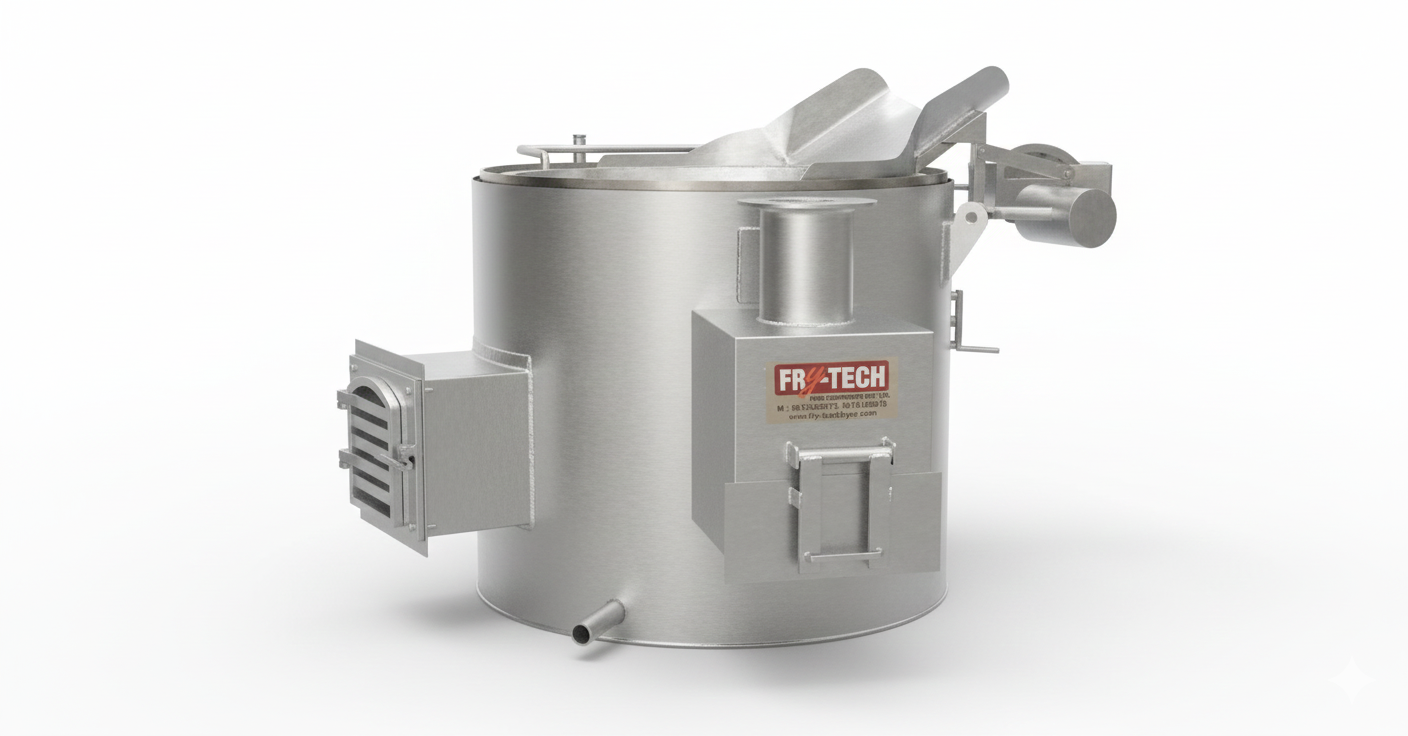
Wood Fired Batch Fryer Type Machine
Wood-Fired Batch
Fryer (often called a "Wood-Fired Bhatti with Heat Exchanger") is the
most cost-effective solution for small to medium-scale snack manufacturers. It
combines the low cost of wood/biomass fuel with the modern technology of
indirect heating to protect oil quality.
In this setup, the
wood is burnt in a separate furnace (usually built next to or under the fryer),
and the heat is transferred via a coil system rather than the flame hitting the
pan directly.
1. Technical
Specifications
|
Feature |
Details |
|
Pan Size |
Standard: 4' x
2', 4.5' x 2.5', or 5' x 3' |
|
Production
Capacity |
30 kg/hr to 150
kg/hr (depends on product) |
|
Fuel |
Firewood, Wood
Briquettes, or Coal |
|
Oil Capacity |
80 to 250 Liters |
|
Material |
SS 304 (Food
Grade) for all contact parts |
|
Power Required |
1.5 HP to 3 HP
(for the oil pump and blower) |
|
Insulation |
50mm - 100mm
high-density Ceramic Wool |
2. Key Components
of the System
- External Wood Furnace: A refractory
brick-lined or heavy-duty MS (Mild Steel) furnace where the wood is burnt.
It is designed to maximize the "Calorific Value" of the wood.
- Heat Exchanger Coil: A series of seamless
Stainless Steel tubes located inside the furnace. The cooking oil
circulates through these tubes, absorbs the heat, and flows into the
frying pan.
- Centrifugal Oil Pump: A high-temperature
pump that constantly moves the oil between the pan and the heating coils.
- Forced Draft Blower: A small electric fan
that blows air into the furnace to control the intensity of the wood fire.
- Tilting Pan (Optional): Many batch fryers
come with a manual or hydraulic tilting mechanism to quickly unload snacks
like Namkeen or Boondi into a cooling tray.
3. Advantages of
the Wood-Fired Batch System
- Fuel Economy: This is the biggest
advantage. Wood-fired systems can reduce fuel costs by up to 60% compared
to Diesel or LPG.
- No Hot Spots: In traditional
"Bhattis," the bottom of the pan gets too hot, burning the oil.
In this system, the oil is heated in coils, so the pan temperature remains
uniform.
- Cooler Environment: Because the furnace is
insulated and the fire is contained, the room temperature stays much
lower, making it more comfortable for workers.
- Low Maintenance: Unlike gas burners that
require frequent cleaning of nozzles, wood furnaces are simple to
maintain.
4. Comparison:
Wood-Fired vs. Gas/Diesel Batch Fryer
|
Factor |
Wood-Fired Batch |
Gas/Diesel Batch |
|
Fuel Cost |
Lowest |
High |
|
Temp. Control |
Manual (via
blower/wood feed) |
Automatic
(Digital PID) |
|
Smoke Management |
Requires a tall
Chimney |
Minimal smoke |
|
Setup Time |
20–30 mins to
heat up |
5–10 mins to heat
up |
|
Labor |
Needs a person to
feed wood |
Fully automatic
ignition |
5. Best Suited For:
- Small scale Namkeen units (Sev, Gathiya,
Bhujia).
- Potato/Banana Chip manufacturers in rural
or semi-urban areas.
- Traditional Sweets (Gulab Jamun, Jalebi) where slow, steady heat is required.

