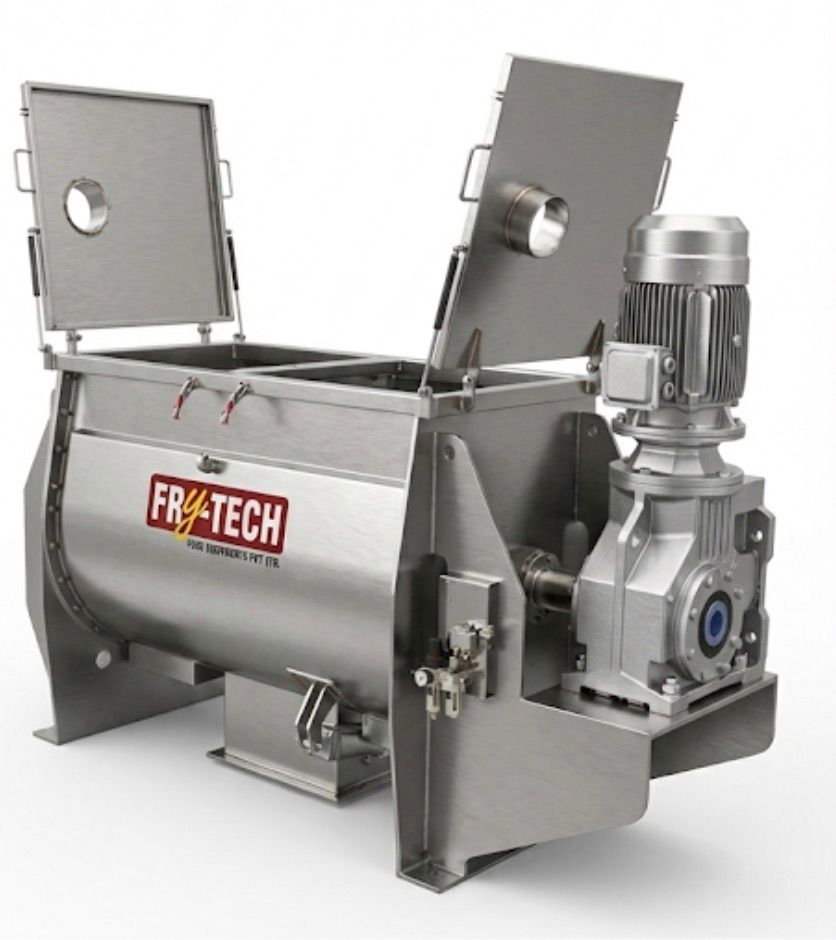
Horizontal Mixer
Horizontal Mixer is a versatile industrial machine
used for blending dry powders, granules, pastes, and slurries. Unlike vertical
mixers, these use a horizontal trough and a central shaft equipped with
specialized agitators to move material in multiple directions simultaneously.
1. Core Types of Horizontal Mixers
Choosing the right horizontal mixer depends entirely on the viscosity
and fragility of your product.
|
Type |
Agitator Design |
Best For... |
|
Ribbon Blender |
Double helical ribbons (inner and outer) |
Dry powders, spices, chemicals, and granules. |
|
Paddle Mixer |
Flat or pitched plates (paddles) |
Fragile items (nuts/dried fruit), wet slurries, or sticky
pastes. |
|
Plough Shear |
Sharp, shovel-like "ploughs" |
High-speed mixing, breaking lumps, and coating particles. |
|
Sigma Mixer |
"Z" shaped heavy-duty arms |
Extremely high-viscosity doughs, rubbers, and adhesives. |
2. Key Working Principles
- Convective
Mixing: In a Ribbon Blender, the outer ribbon moves material
toward the center, while the inner ribbon moves it toward the ends. This
creates a "convection" flow that ensures 98%+ homogeneity.
- Fluidization:
In a Dual-Shaft Paddle Mixer, the paddles lift the material into a
"weightless" zone, allowing particles of different densities to
mix without separating.
- Low
Shear: Most horizontal mixers are designed to mix without generating
significant heat, which is vital for temperature-sensitive food
ingredients or chemicals.
3. Technical Features & Automation
Modern industrial units (like those from Silvestri, Pratham
Engineering, or Lithotech) include:
- Jacketed
Troughs: An outer chamber for circulating hot water, steam, or chilled
water to control batch temperature.
- Pneumatic
Discharge: A "bomb-bay" or slide gate at the bottom center
for rapid, clean emptying.
- PLC
Controls: Touchscreens to save "recipes" with specific
mixing times and shaft speeds 20 to 60 RPM)
- Liquid
Injection: A spray bar can be mounted on top to add oils, perfumes, or
water evenly into a powder mix.

