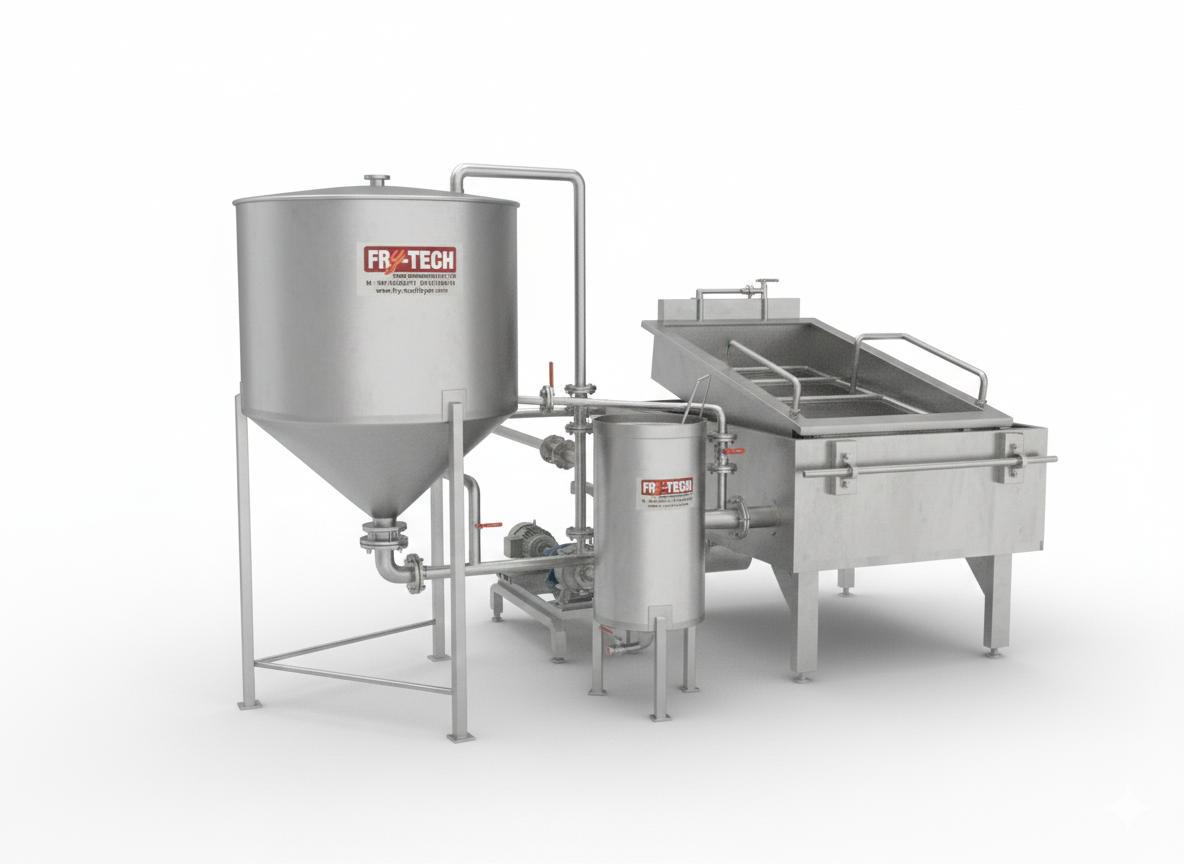
Inbuilt Heat Exchanger Wood Based Rectangal Batch Fryer
A wood-based
rectangular batch fryer with an inbuilt heat exchanger is an industrial food
processing machine designed for frying snacks like potato chips, namkeen, and
fryums.1 Unlike traditional "Inbuilt direct-fired" systems
where the flame hits the pan directly, this system uses a Heat Exchanger
(HE) to heat the oil indirectly, ensuring better oil quality and fuel
efficiency.2
1. Technical
Specifications
Most industrial models
(like those from Gungunwala, Fry-Tech, or Blaze) follow these general
parameters:
|
Feature |
Typical
Specification |
|
Capacity |
50 – 400 kg/hr
(depending on product type) |
|
Material |
Food-grade Stainless
Steel (SS 304) |
|
Fuel |
Firewood, Wood
Pellets, or Briquettes |
|
Oil Holding
Capacity |
110 – 220 Liters |
|
Pan Dimensions |
Ranges from 4' x 2'
to 5' x 3' |
|
Power Required |
3 HP to 5.5 HP (for
oil circulation and fans) |
|
Automation |
Semi-automatic to
Fully Automatic |
2. How the Inbuilt
Heat Exchanger Works
The core of this
system is indirect heating. Instead of heating the frying pan directly
with a wood fire, the oil follows a specific path:
- Combustion Chamber: Wood is burned in a separate furnace box
(usually located at the bottom or side).
- Tube Network: The cooking oil is pumped through a
series of SS seamless tubes (coils) located inside the heat
exchanger.
- Heat Transfer: The heat from the wood fire warms the
tubes, which in turn heats the oil flowing inside them.
- Circulation: An oil pump continuously moves the hot
oil from the heat exchanger into the frying pan and back again through a
filtration system.
3. Key Features
& Benefits
- Oil Longevity: Because the flame never touches the oil
pan directly, the oil doesn't "crack" or burn as easily. This
significantly extends the life of the edible oil.
- Temperature Control: These fryers often include a digital
temperature controller. Even with wood fuel, the system can regulate the
flow of oil to maintain a consistent frying temperature ( to ).
- Fuel Efficiency: The "three-pass" or
"two-pass" design of the heat exchanger ensures maximum heat
absorption from the wood, reducing fuel consumption by up to 20–30%
compared to traditional bhattis.
- Tilting System: Most rectangular models feature a manual
or automatic tilting mechanism, allowing the operator to unload an entire
batch of snacks in one stroke, ensuring uniform frying time.
- Filtration: Usually equipped with a bucket-type
continuous filtration system that removes food particles (fines) to
keep the oil clean.
4. Typical
Applications
- Potato & Banana Chips: High-quality finish without burnt spots.
- Namkeen & Dals: Ideal for Moong Dal, Chana Dal, and Sev.
- Pellets/Fryums: High-capacity frying with quick recovery
of oil temperature.

