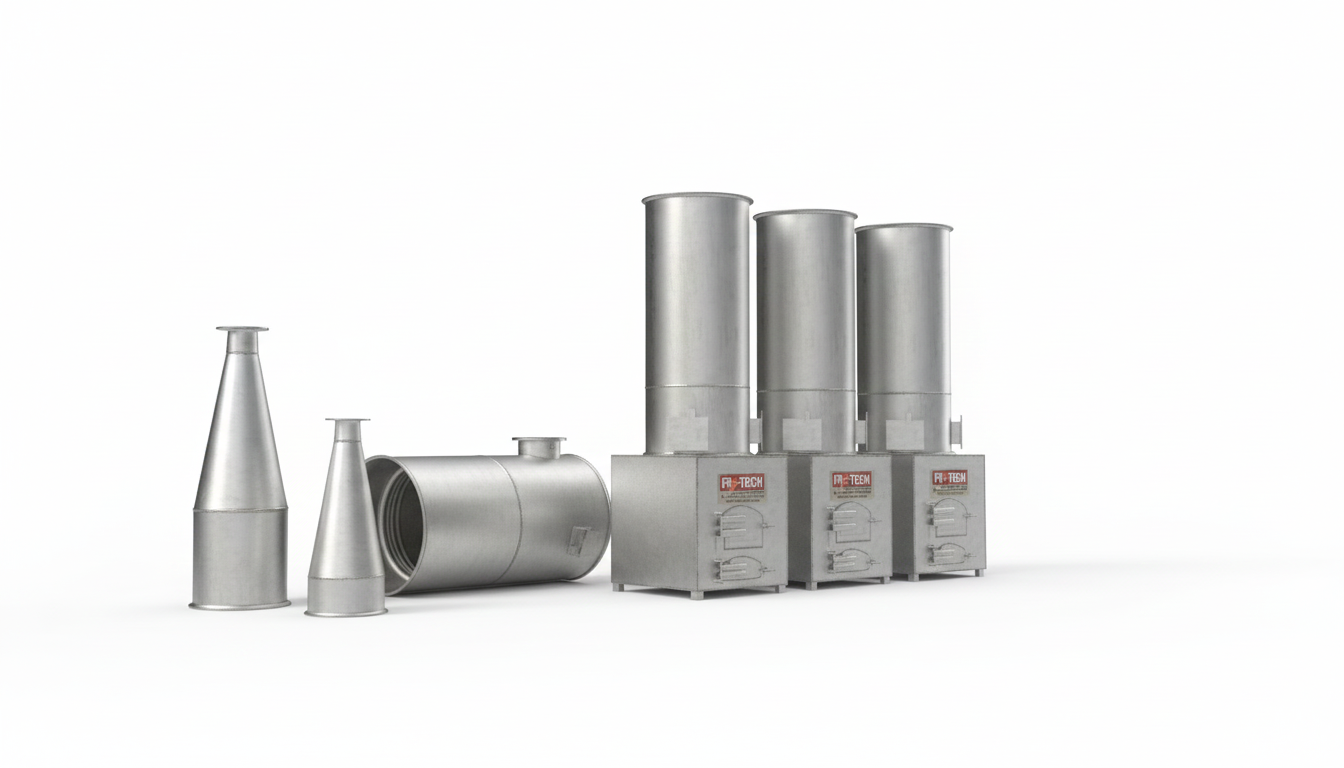
Direct Wood Fired Heat Exchanger For Edible Oil heating
Direct Wood-Fired
Heat Exchanger (often called an "Indirect Frying System") is used to
heat edible oil without exposing it to a direct flame. This prevents oil
carbonization and extends the "life" of the oil.
The terms 2-Pass
and 3-Pass refer to the number of times the hot flue gases (smoke and heat from
the wood fire) travel through the internal tube bundle before exiting the
chimney.
1. Two-Pass
Wood-Fired Heat Exchanger
The 2-pass system
is a simpler, more compact design usually found in smaller batch frying setups.
- Pass 1: The wood burns in the furnace
(combustion chamber), and the hot gases move forward through the primary
tubes.
- Pass 2: The gases hit a reversal chamber
at the back and travel through a second set of tubes back toward the
front, where they exit into the chimney.
- Best For: Small-scale units 100 kg/hr production). It is easier to clean but slightly less fuel-efficient
than a 3-pass system.
2. Three-Pass
Wood-Fired Heat Exchanger
The 3-pass system
is the industry standard for high-efficiency frying lines. It extracts the
maximum possible heat from the wood before releasing it.
- Pass 1: Combustion in the furnace (Radiant
zone).
- Pass 2: Flue gases travel back to the
front through the first set of smoke tubes (Convection zone).
- Pass 3: Gases travel once more to the rear
through a final set of tubes before exiting.
- Efficiency: Offers up to 75%–82% thermal
efficiency, significantly reducing wood consumption.
Comparison: 2-Pass
vs. 3-Pass
|
Feature |
2-Pass System |
3-Pass System |
|
Fuel Efficiency |
Moderate
(~65-70%) |
High (~80%+) |
|
Wood Consumption |
Higher |
Lower (Saves
approx. 15-20% wood) |
|
Initial Cost |
Lower |
Higher (More
tubes/complex fabrication) |
|
Maintenance |
Very Easy to
clean |
Requires regular
cleaning of more tubes |
|
Ideal For |
Batch Fryers /
Small setups |
Continuous Fryers
/ Large factories |
3. Key Component:
The Coil (Oil Side)
While the
"passes" describe the flue gas, the Edible Oil flows through a
separate Seamless SS 304 Coil.
- Velocity: The oil is pumped at a specific
velocity to ensure it doesn't "crack" or burn
inside the tubes.
- Surface Area: 3-pass systems provide more
surface area for the oil to absorb heat, meaning you can heat more oil
with less wood.

