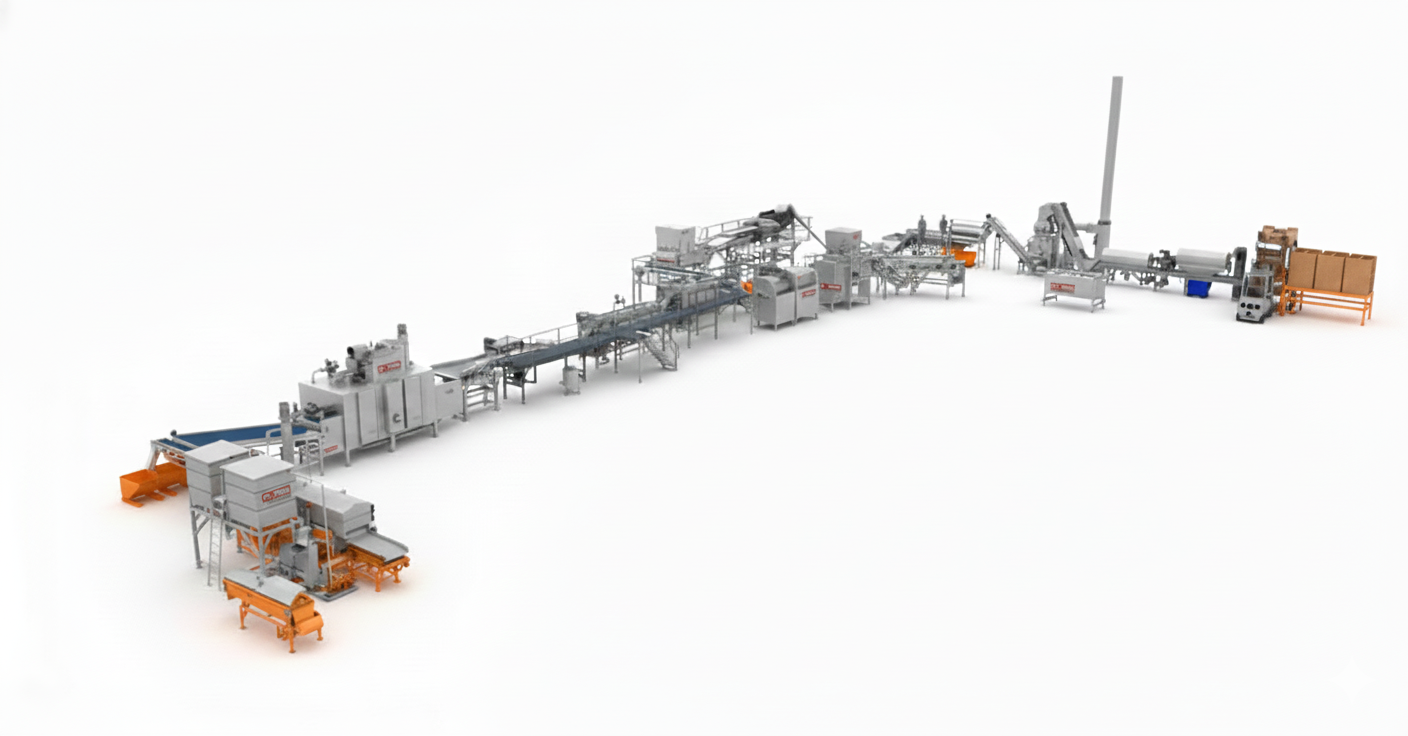
Potato Starch Machinery
Fully Automatic Potato Starch Production Line with a
finished product capacity of 500 kg/hr is a high-end industrial
installation. Unlike a starch recovery system (which collects
waste starch from a chip line), this is a primary extraction plant that
converts raw potatoes into high-purity starch powder.
To produce 500 kg of finished starch per hour, you
typically need to process 3 to 4 tons of raw potatoes per hour (based
on a standard 15–18% starch yield).
1. Technical Specifications (500 kg/hr Output)
|
Feature |
Details |
|
Input
Capacity |
3,000
– 4,000 kg/hr (Raw Potatoes) |
|
Output
Capacity |
500
kg/hr (Standard Starch Powder) |
|
Electricity
Load |
150
kW – 200 kW (Total installed power) |
|
Water
Consumption |
8 –
12 m3/hr (Soft water preferred) |
|
Steam/Heat
Requirement |
0.6
– 1.0 Ton steam/hr (for Flash Dryer) |
|
Operator
Requirement |
4 –
6 Skilled personnel per shift |
|
Land
Area Required |
Approx.
30m x 8m (240 sq. meters) |
2. Process Flow & Machine Details
The production line follows a "Wet Milling"
process to ensure 99% purity.
Section A: Cleaning & Washing
- Dry
Sieve / De-stoner: Removes sand, stones, and heavy mud using a
rotating screen without using water.
- Rotary
Drum Washer: Uses a paddle-wash system to clean the potatoes
thoroughly.
- Secondary
Peeler/Cleaner: Often a brush-roller machine that ensures the
potatoes are 100% clean before crushing.
Section B: Crushing & Extraction
- High-Speed
Rasper: The heart of the plant. It rotates at 2000+ RPM to break
potato cells and release starch granules. High dissociation rates (98%+)
are critical here.
- Centrifugal
Sieve (Extraction): A multi-stage system (usually 4–5 stages) that
separates the starch milk from the potato pulp (fiber).
Section C: Refining & Concentration
- Desander: A
cyclone-based system that removes fine sand particles from the starch
milk.
- Hydrocyclone
Station: A 12–18 stage series of small cyclones that wash the starch
milk with fresh water to remove proteins, fats, and cell sap, resulting in
pure "white" starch milk.
Section D: Dewatering & Drying
- Vacuum
Filter / Peeler Centrifuge: Reduces the moisture of the starch milk
from 60% down to 38–40%, forming a "starch cake."
- Flash
Dryer (Airflow Dryer): A tall vertical pipe system where hot air
instantly dries the starch cake into a fine powder (13–18% final
moisture).
- Sifting
& Packaging: A vibrating screen removes any lumps, followed by an
automatic bagging machine (25kg or 50kg bags).
3. Utility & Infrastructure Requirements
- Water
Quality: Starch extraction requires high volumes of water. Using Soft
Water (low calcium/magnesium) is mandatory to prevent the starch from
turning grey or yellow.
- Waste
Management: The plant produces "Potato Pulp" (fiber) and
"Cell Liquid." The pulp is usually sold as high-value animal
feed, while the liquid requires an Effluent Treatment Plant (ETP).
- Boiler: You will need a small industrial boiler (Gas, Diesel, or Wood-fired) to provide the heat for the Flash Drying stage.

