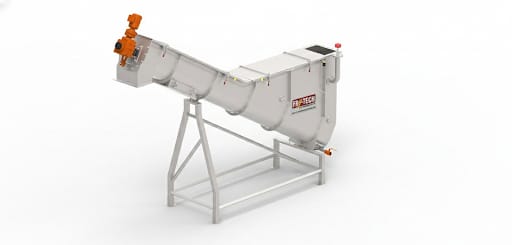
Screw Conveyer Blancher
A Screw Conveyor Blancher (also known as a Spiral
Blancher) is a continuous food processing machine used to heat-treat fruits,
vegetables, and legumes. It
uses a rotating screw (auger) to move the product through a hot water bath or
steam chamber at a controlled speed to ensure uniform enzyme deactivation.2
1. Core Technical Specifications
While specifications vary by manufacturer, a standard
industrial unit typically falls within these ranges:
|
Feature |
Typical Specification |
|
Capacity |
300 kg/hr to 5,000 kg/hr (High-end models reach 40 t/h) |
|
Material |
Food-grade Stainless Steel (SS 304 or SS 316) |
|
Temperature |
Adjustable, typically 70°C to 100°C |
|
Blanching Time |
3 to 15 minutes (Adjustable via VFD/Speed Control) |
|
Power |
3 HP to 10 HP (depending on screw size and length) |
|
Heating Source |
Direct Steam Injection or Electric Heat Exchangers |
|
Dimensions |
Often 20+ feet (6m) in length for industrial throughput |
2. Working Mechanism
- Feeding:
Raw product enters through an intake hopper at one end.
- Conveying:
A large-diameter helical screw rotates inside a "U" shaped or
cylindrical trough, pushing the product forward.
- Heating:
The trough is filled with hot water or injected with steam. In water-based
systems, the screw ensures the product stays submerged.
- Discharge:
At the end of the screw, a "ferris wheel" or scraper discharge
mechanism lifts the product out to the next stage (usually a cooling
conveyor).
- Control:
A PLC (Programmable Logic Controller) manages the screw rotation speed
(residence time) and the steam valves (temperature).
3. Key Components
- Auger/Screw:
The central rotating part.7 Some specialized screws have holes
(perforated flights) to allow water to flow freely while moving the
solids.
- Steam
Manifold: A series of pipes and nozzles at the bottom of the trough for
even heat distribution.
- Insulated
Hood: A stainless steel cover, often with glass wool insulation, to
prevent heat loss and ensure operator safety.
- VFD
(Variable Frequency Drive): Allows operators to change the speed of the
motor to match the specific blanching requirements of different crops
(e.g., peas vs. potatoes).10
4. Main Advantages
- Uniformity:
Unlike batch blanchers, every piece of produce stays in the heat for the
exact same duration.
- Continuous
Flow: Ideal for large-scale production lines where pausing for batches is
inefficient.
- Enzyme
Deactivation: Effectively stops the enzymes that cause browning and loss
of flavor during freezing or canning.
- Softening:
Pre-cooks tough tissues (like carrots or beets) to make further processing
(like pulping) easier.
5. Typical Applications
- Vegetables:
Green peas, carrots, potatoes, sweet corn, and cauliflower.
- Fruits:
Mango slices, amla (for segment separation), and dates.
- Seafood:
Shrimps and mussels (without shells).
- Legumes:
Beans and chickpeas before canning.

