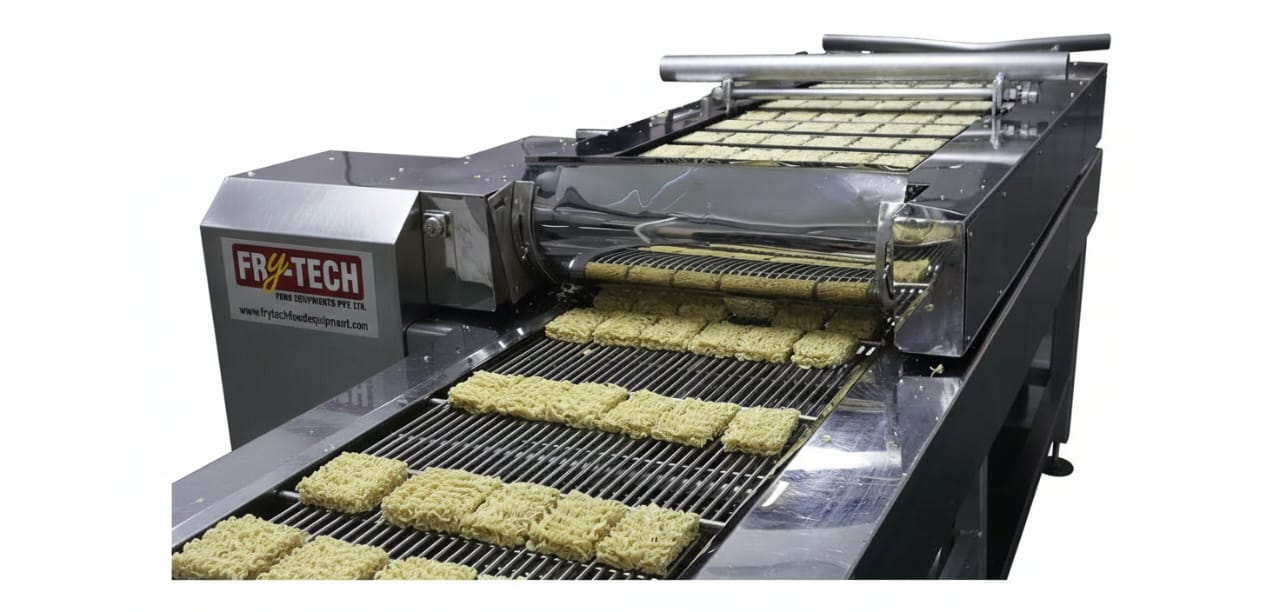
Instant Noodle Frying Machine
We are a hybrid manufacturing and equipment supply company. While we manufacture
a core range of high-quality machinery in-house, we also collaborate with
leading global brands to provide our clients with a complete, end-to-end
production solution."
"A blend of In-house Engineering and Global Brands. We manufacture
specialized machines at our facility and source premium branded equipment to
ensure you get the best of both worlds."
Option 3: Focus on "Total Solutions" (Best for Sales
Proposals)
"To provide a total turnkey solution, we offer a mix of our own
manufactured equipment and carefully selected branded machinery. This allows us
to deliver high performance while keeping the entire project cost-effective for
you."
An Instant Noodle Frying Machine (also known as a
Continuous Noodle Fryer) is the most critical component in a fried noodle
production line. Its primary job is to flash-fry steamed noodles, which removes
moisture (dehydration), sets the shape, and creates the porous structure that
allows the noodles to cook in just 2–3 minutes with hot water.1
1. Technical Specifications (Continuous Type)
Heavy industrial fryers for instant noodles are built for
high-speed, 24/7 output.
|
Feature |
Specification Range |
|
Capacity |
20,000 to 200,000+ packs per 8 hours |
|
Frying Temperature |
140°C to 160°C (Zoned Control) |
|
Frying Time |
60 to 90 seconds (Adjustable) |
|
Power Consumption |
30 kW to 150 kW (depending on line size) |
|
Material |
Food Grade Stainless Steel (SS 304) |
|
Oil Management |
Automatic replenishment & continuous filtration |
2. The Frying Mechanism
The machine uses a specialized "Basket &
Cover" system to ensure uniform frying:
- Feeding:
Pre-cut and folded noodle "cakes" (square or round) are dropped
into individual metal baskets.
- Hold-Down:
A top cover (hold-down plate) lowers over the baskets. This
prevents the noodle cakes from floating or falling apart once they hit the
hot oil.
- Immersion:
The baskets travel through a long "U" shaped tank filled with
palm oil.
- Graduated
Heating: The fryer is divided into 3–5 heat zones. The oil at the
entry is slightly cooler to prevent burning, while the middle zone is the
hottest for maximum dehydration.
- De-oiling:
As the baskets exit, Air Knives (high-pressure blowers) blast away
excess surface oil to reduce the final fat content of the noodles.
3. Key Components
- Fryer
Frame Lifting: A motorized screw or pneumatic cylinder system that
lifts the entire conveyor and hood out of the oil. This is
essential for cleaning and to prevent the noodles from burning during a
sudden power failure or line stoppage.
- Heat
Exchanger: Most modern plants use an external heat exchanger. Instead
of heating the oil directly in the tank, the oil is circulated through an
external heater to prevent localized "hot spots" that degrade
oil quality.
- Oil
Circulation & Slag Filter: A continuous pump system pulls oil
through a "slag filter" to remove tiny noodle bits (crumbs) that
would otherwise burn and turn the oil bitter.
- Exhaust
Hood: A heavy-duty stainless steel hood with a "cyclone
separator" to capture oil mist and steam, keeping the factory floor
clean and safe.
4. Why Frying is Necessary
- Flash
Dehydration: It reduces moisture from ~35% down to 3–5%
instantly.
- Porous
Structure: The rapid evaporation of water creates tiny holes in the
noodle strand, which act as "tunnels" for hot water to enter
when the consumer prepares the meal.
- Shelf
Life: Low moisture content prevents bacterial growth, allowing the
noodles to last for 12 months without preservatives.
5. Summary for Business Planning
If you are planning a line, remember that as a manufacturer
and supplier, you can offer:
- Customized
Moulds: To make "Cup" noodles (round) or "Bag"
noodles (square) in the same machine.
- Hybrid
Solutions: Combining your locally manufactured conveyors/frames with branded
PLC systems (like Siemens or Schneider) and branded burners
(like Riello) for the heat exchanger.

