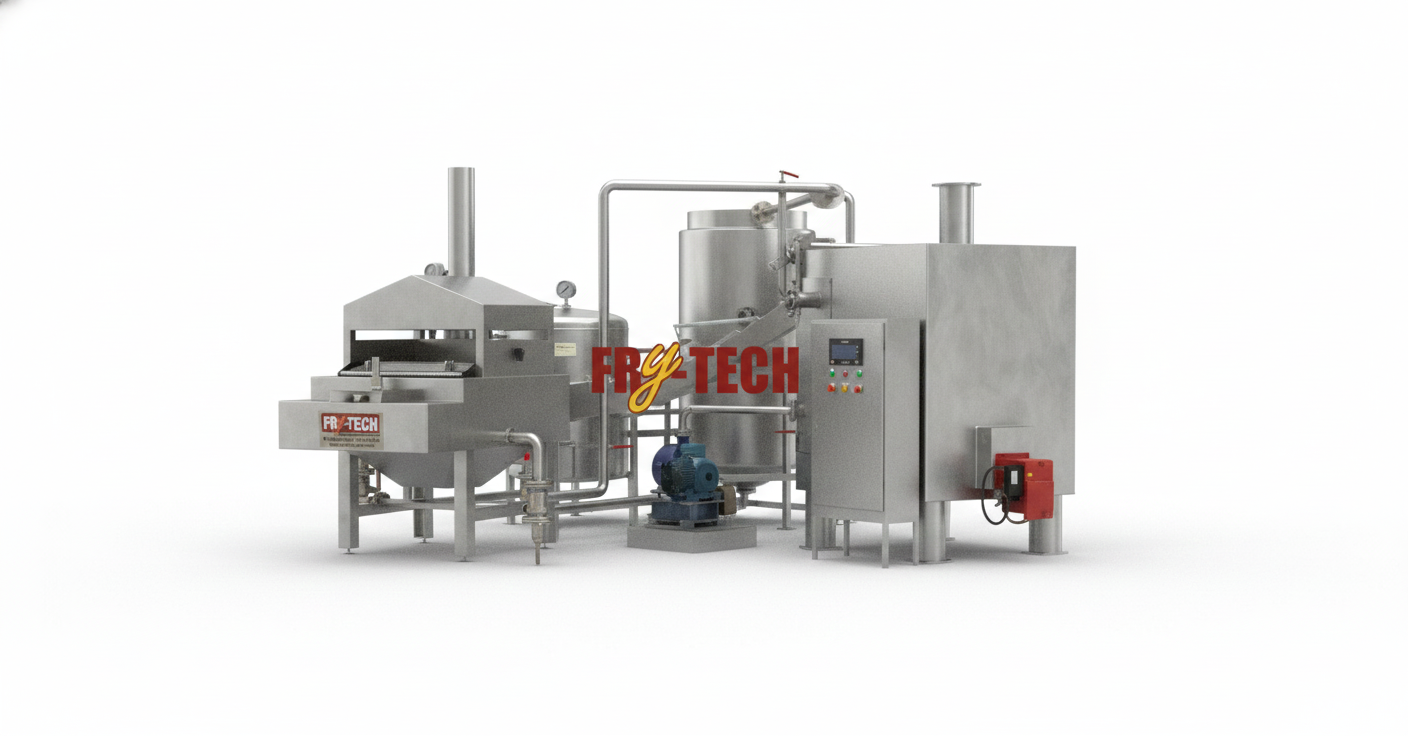
External Heat Exchanger Gas / Diesel Based Continuous Fryer
Continuous Fryer with an External Heat Exchanger is the gold
standard for high-volume snack production (300 kg/hr to 1000+ kg/hr). Unlike
batch fryers, this system uses a separate furnace unit (the external heat
exchanger) to heat the oil before pumping it into the frying chamber.1
This setup is preferred by large-scale manufacturers because it provides
the most "gentle" heating, preventing oil degradation even during
24/7 operations.
Technical Specifications
The following are typical specs for a medium-to-large industrial line:
|
Feature |
Standard
Details |
|
Production Capacity |
300 / 500 / 1000 kg/hr
(customizable) |
|
Fuel Source |
Diesel, LPG, Natural Gas,
or Thermic Fluid |
|
Oil Holding Capacity |
250 – 1,500+ Liters
(system-wide) |
|
Power Consumption |
6.5 HP to 20 HP (includes
conveyor and high-volume pumps) |
|
Material |
SS 304 (Chamber) / SS 316
(Optional for high-salt products) |
|
Conveyor System |
Dual mesh belts (Submerger
belt + Take-out belt) |
|
Temperature Control |
PLC with VFD (Variable
Frequency Drive) |
Core Components & System Design
- External
Heat Exchanger (Furnace): Located outside the frying room or at a
distance.2 It consists of a large SS coil. The burner
(Gas/Diesel) fires into this chamber, heating the oil as it flows through
the coil.3
- Double Mesh
Belt System:
- Bottom
Belt: Carries the product through the oil.4
- Submerger
(Top) Belt: Keeps floating items (like pellets or chips) fully
submerged for uniform cooking.5
- High-Volume
Circulation Pump: Moves the entire oil volume through the heat
exchanger multiple times per hour.6 This creates a
"longitudinal flow" that moves the product forward and maintains
a $\pm 1$°C temperature tolerance.
- Automatic
Fines Removal: A continuous belt-type or bucket filter removes food
particles (fines) instantly. Because the oil is heated externally, these
fines never sit on a hot surface, preventing "black spots" on
snacks.
- Hood
Lifting System: Most continuous fryers have a motorized lifting
mechanism that raises the entire hood and conveyor for easy cleaning (CIP
- Clean In Place).7
Why Choose "External" over "Inbuilt"?
- Zero
Thermal Shock: In inbuilt systems, the flame is close to the
pan. In external systems, the heating happens in a controlled coil,
which keeps the "film temperature" of the oil extremely low.8
- Rapid Oil
Turnover (OTR): These systems are designed for a low oil-to-product
ratio, meaning fresh oil is added frequently to replace what is absorbed,
keeping the oil fresh.9
- Safety
& Environment: Since the combustion (flame) happens in a separate
external unit, the frying area remains cool and free of exhaust gases.10
- Scale: External
exchangers can be much larger and more powerful, supporting production
lines that run thousands of kilograms per day.
Best For
- Extruded
Snacks: Kurkure, Cheetos-style curls.11
- Pellets: 2D/3D
Fryums.
- Large Scale
Namkeen: Sev, Gathiya, Bhujia.12
- Nuts: Peanuts and green peas.

