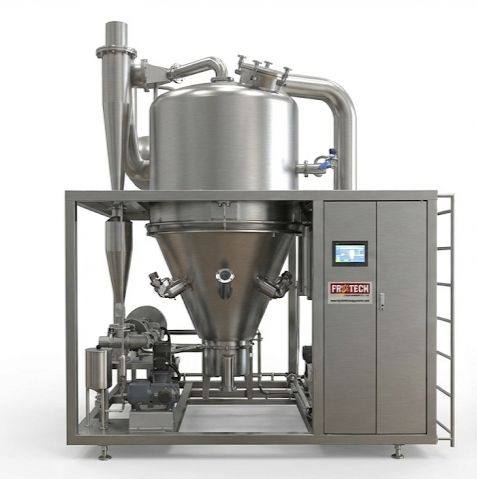
Spray Dryer Machine
Spray Dryer Machine is a highly efficient industrial system that
converts liquid feeds (solutions, emulsions, or slurries) directly into a fine,
dry powder in a single step. It is the gold standard for producing
milk powder, instant coffee, and pharmaceutical granules.
1. The Spray Drying Process (Working Principle)
The machine operates on the principle of increasing the surface area of
the liquid to allow for nearly instantaneous evaporation.
- Atomization:
The liquid feed is pumped to an atomizer (either a high-speed rotary disk
or a pressure nozzle) which breaks the liquid into millions of
micro-droplets (20µm – 180µm).
- Hot Air
Contact: These droplets are sprayed into a large Drying Chamber where they
meet a stream of hot air ( 150 C to 300 C
- Evaporation:
Moisture evaporates in seconds. Interestingly, the rapid
evaporation keeps the actual particle temperature low, protecting
heat-sensitive nutrients or flavors.
- Separation:
The dried powder falls to the bottom or is sucked into a Cyclone Separator,
which uses centrifugal force to separate the solid powder from the humid
exhaust air.
2. Types of Atomizers (The "Heart" of the Machine)
|
Type |
Best For |
Characteristics |
|
Rotary Atomizer |
High capacity (Dairy/Chemicals) |
Uses a spinning disk (up to 30,000 RPM); handles viscous/abrasive
liquids well. |
|
Pressure Nozzle |
Coarse, uniform granules |
Forces liquid through a small hole; produces free-flowing powder with
high bulk density. |
|
Two-Fluid Nozzle |
Lab scale / R&D / Viscous feeds |
Uses compressed air to "shear" the liquid; ideal for
producing ultra-fine powders. |
3. Technical Specifications
- MOC:
Usually SS 304 L for food/pharma contact parts and SS 304 for the outer
structure.
- Heating:
Electric heaters (for small units) or Steam/Gas/Diesel fired burners (for
large plants).
- Collection:
Cyclone Separator + Bag Filter (to capture 99.9% of the powder).12
- Control:
PLC based touch-panel with data logging for temperature and feed rate.

