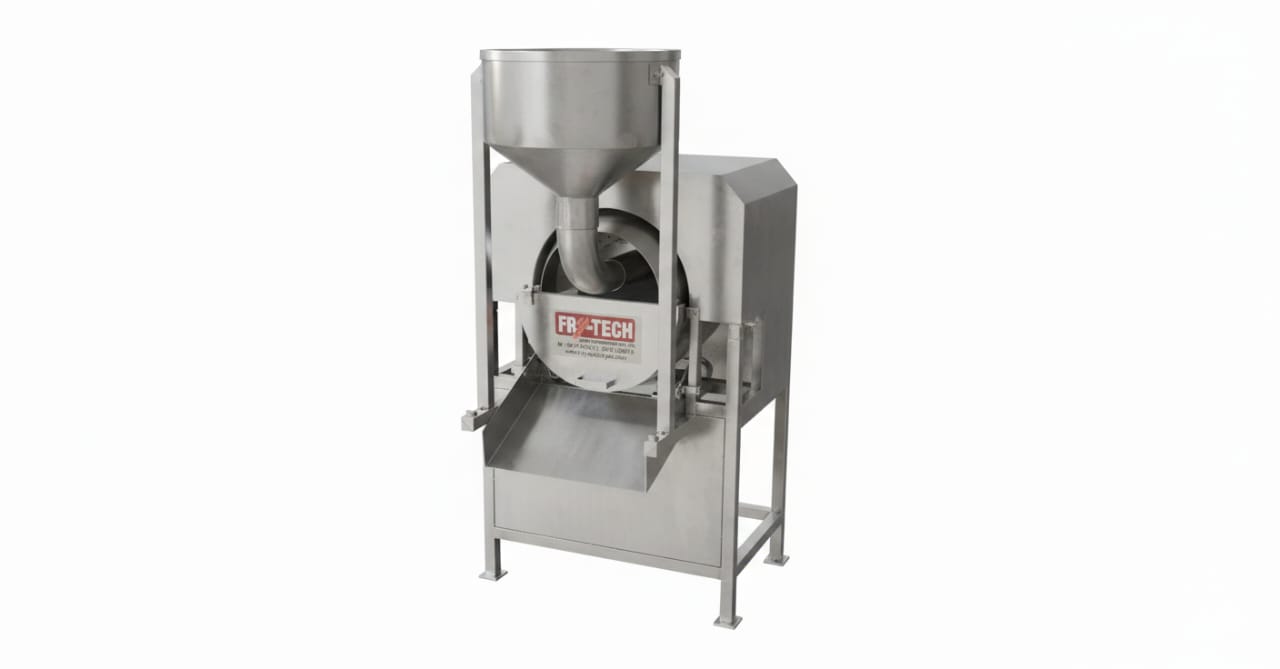
Dried Fruits Roaster Machine
Screw-type roasting
machines for dried fruits and nuts (also known as Spiral Roasters or Screw
Conveyor Roasters) are designed for continuous, high-volume production. Unlike
drum roasters that tumble the product in a batch, screw roasters move the
product through a heated tube or trough using a large internal screw (auger),
ensuring that every single piece of fruit or nut receives identical heat
exposure.
1. How the
Screw-Type System Works
- Infeed: Raw dried fruits (like raisins or
dates) or nuts (peanuts, cashews) enter a hopper.
- Conveyance: A motor-driven screw shaft
rotates inside a stationary tube or "U" trough.
- Heating: Heating elements (electric, gas,
or thermic oil) are wrapped around the tube or embedded below the trough.
As the screw turns, it gently pushes the product forward through several
heat zones.
- Uniformity: The constant turning of the
screw ensures that the product is continuously "turned over,"
preventing one side from scorching.
- Discharge: The roasted product exits the
other end, usually onto a cooling conveyor.
2. Technical
Specifications for Industrial Models
|
Feature |
Standard
Industrial Spec |
|
Production
Capacity |
100 kg/hr to
2,000 kg/hr |
|
Material of
Construction |
Food-grade SS 304
or SS 316 |
|
Heating
Temperature |
Adjustable up to 250°C |
|
Screw Type |
Ribbon or
Full-flight helical screw |
|
Control System |
PLC with VFD
(Variable Frequency Drive) to adjust roasting time |
3. Advantages Over
Drum Roasters
- Continuous Output: No downtime for loading
and unloading batches.
- Precise Residence Time: You can precisely
control how long the product stays in the heat by adjusting the screw's
rotation speed.
- Space Efficient: Because the roasting
happens inside a narrow tube, these machines take up less floor space than
massive rotating drums.
- Minimal Breakage: The gentle sliding
motion of the screw is often safer for fragile dried fruits than the
"tumbling" of a drum.
4. Key Components
for "Automatic" Operation
- Variable Speed Drive: Essential for
switching between different products (e.g., a 10-minute roast for cashews
vs. a 3-minute "flash roast" for raisins).
- Thermal Insulation: High-quality glass
wool or rock wool insulation keeps the heat inside the screw chamber,
reducing energy costs.
- Automatic Feeding: Integrated with a
vibratory feeder to ensure a steady, even stream of product enters the
screw.
- Inbuilt Cooling: The final section of some
screws is unheated or fan-cooled to bring the product temperature down
before packaging.

