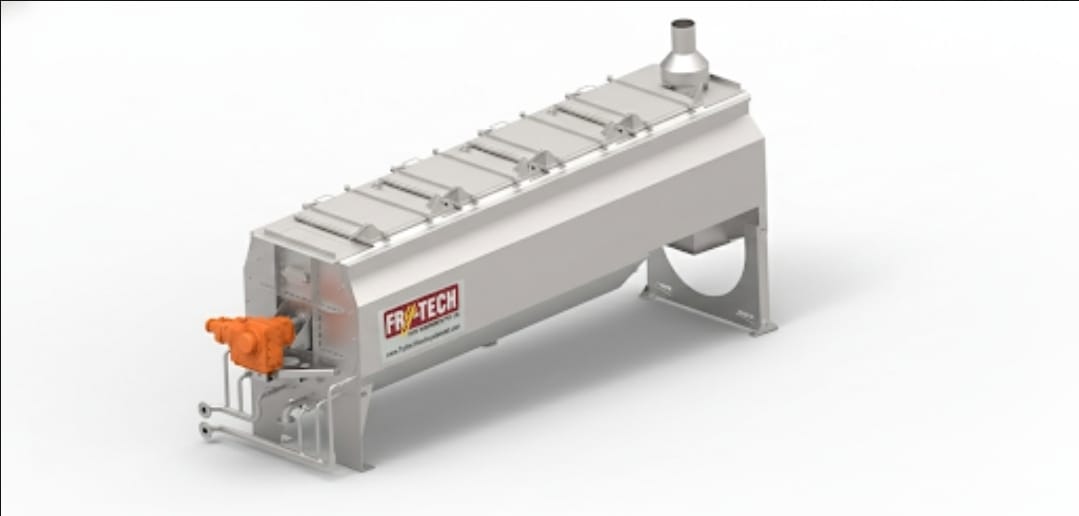
Drum Blancher
Automatic Drum Blancher (also known as a Rotary Drum
Blancher) is an essential piece of equipment in large-scale snack and vegetable
processing lines. It is primarily used to deactivate enzymes, preserve color,
and remove surface starch from products like potato slices, carrots, peas, and
leafy greens before they are fried or frozen.
1. How it Works: The Rotary Screw Principle
Unlike a simple water tank, the drum blancher uses a
continuous "screw-flight" mechanism inside a perforated rotating
drum:
- Feeding:
Product enters through an infeed hopper into a rotating, perforated
stainless steel drum submerged in hot water.
- Controlled
Transport: An internal Auger (Screw) welded to the drum's interior pushes
the product forward at a precise, constant speed.
- Heat
Treatment: Steam or electric heating elements keep the water at a steady
temperature (70°C to 95°C).
- Discharge:
At the end of the drum, a scooping mechanism lifts the blanched product
and deposits it onto a discharge chute or de-watering belt.
2. Key Advantages of the Drum Design
- Consistent
Blanching Time: Because the screw flights have a fixed pitch, every piece
of fruit or vegetable stays in the hot water for the exact same amount of
time.
- Uniform
Temperature: The rotation of the drum creates natural turbulence, ensuring
there are no "cold spots" in the water.
- Low
Product Damage: The gentle tumbling action is safer for fragile items
(like sliced mushrooms or peaches) compared to high-pressure spray
blanchers.
- Space
Saving: A drum blancher can process high volumes (up to 5 tons/hr) in a
much smaller floor footprint than a long belt-type blancher.
3. Technical Specifications
|
Feature |
Standard Industrial Spec |
|
Capacity Range |
200 kg/hr to 5,000 kg/hr |
|
Material |
All SS 304 or SS 316L Stainless Steel |
|
Heating Source |
Steam Injection (Most Common), Electric, or Thermic Oil |
|
Automation |
PLC Touchscreen with PID Temperature Control |
|
Residence Time |
Adjustable (typically 1 to 10 minutes) via VFD |
|
Insulation |
Double-jacketed body to prevent heat loss and operator
burns |
4. Integration into Production Lines
The drum blancher is almost always placed between the
cutting/slicing stage and the drying/frying stage:
- Potato
Chips Line: Removes surface starch so chips don't stick together in the
fryer and prevents the "browning" (Maillard reaction) caused by
excess sugars.
- Frozen
Vegetable Line (IQF): Inactivates enzymes to stop the aging process before
the vegetables enter the blast freezer.
- French
Fries Line: Softens the potato strips to ensure the final product has a
"mealy" interior and crispy exterior.

