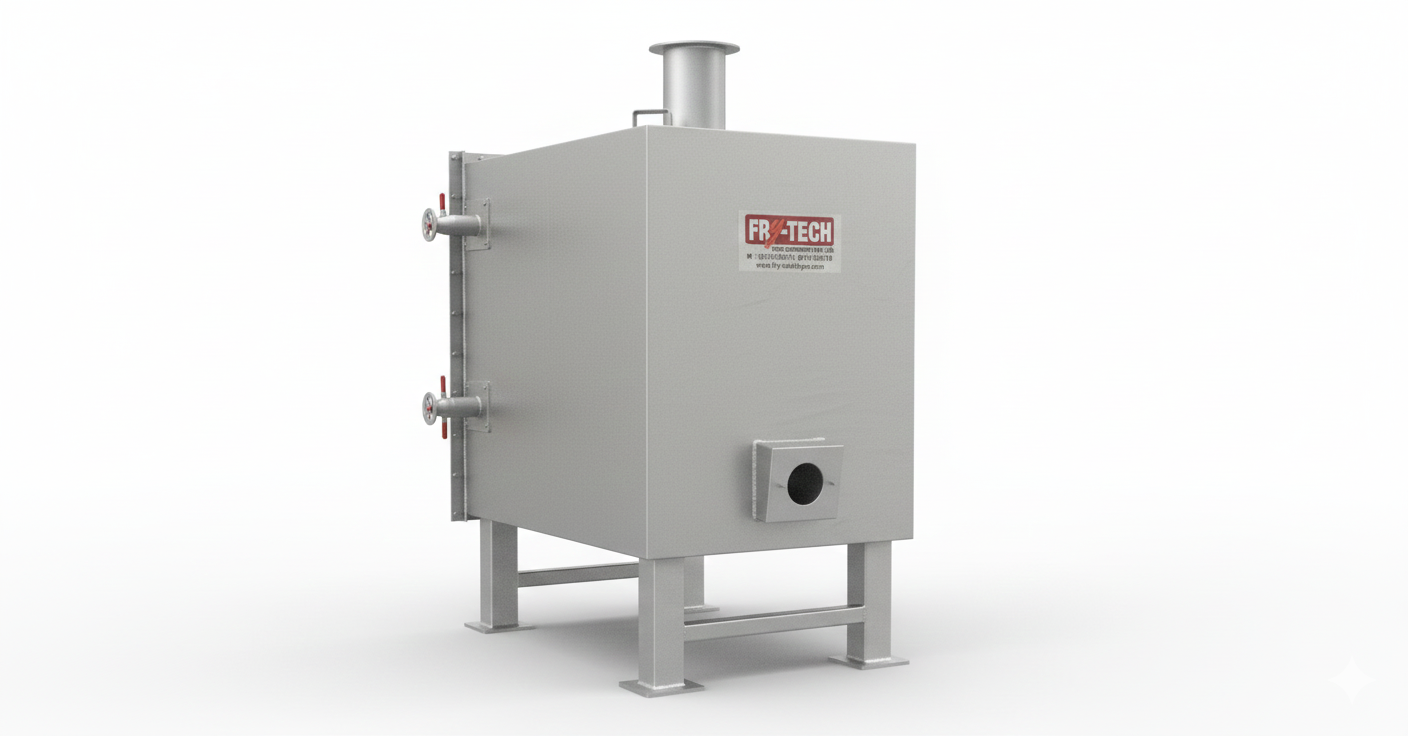
Pellet Fired Heat Exchanger
Wood Pellet Fired Heat Exchanger is an eco-friendly and cost-effective
heating solution widely used in food processing for frying, roasting, and
drying. By switching from Diesel or LPG to wood pellets, factories can reduce
their fuel costs by 60% to 70%.
In Ahmedabad, these systems are typically designed as Indirect Fired
Heat Exchangers, where the combustion of pellets happens in a separate chamber,
ensuring that no smoke or ash touches the food.
1. Technical Specifications
|
Feature |
Small Capacity (Batch) |
Industrial Capacity (Continuous) |
|
Heat Output |
1,00,000 Kcal/hr |
2,00,000 to 10,00,000 Kcal/hr |
|
Fuel Type |
6mm – 10mm Wood/Biomass Pellets |
Pellets or Agri-Waste Briquettes |
|
Material |
MS (Body) / SS 304 (Heater Tubes) |
Full SS 304 with Refractory Lining |
|
Feeding |
Automatic Screw Feeder |
Variable Speed PLC-Controlled Feeder |
|
Efficiency |
80% to 90% |
Up to 92% (High Efficiency Models) |
|
Operating Temp |
50 to 200 Dc |
Upto 200 C |
Heat Transfer: The hot flue gases pass
through a Shell and Tube or Fin-type Heat Exchanger.
Medium Heating: The secondary medium
(Air for dryers or Edible Oil for fryers) circulates around these tubes,
absorbing the heat.
Exhaust: Cleaned exhaust gases are
released through a chimney, while the ash is collected in a bottom tray for
easy disposal.
Key Benefits for
Food Plants
- Huge Savings: Wood pellets cost approx. 10–12/kg
compared to LPG at 90+/kg.
- Clean Flame: Pellets produce minimal ash 2% and no sulfur or oily odors, maintaining food hygiene.
- Stable Heat: Unlike wood logs, pellets have a
consistent density, providing a very steady temperature which is critical
for frying snacks like Namkeen or Potato Chips.
- Easy Retrofit: Most pellet burners can be attached to your existing gas/diesel fryer or tray dryer with minimal modification.

