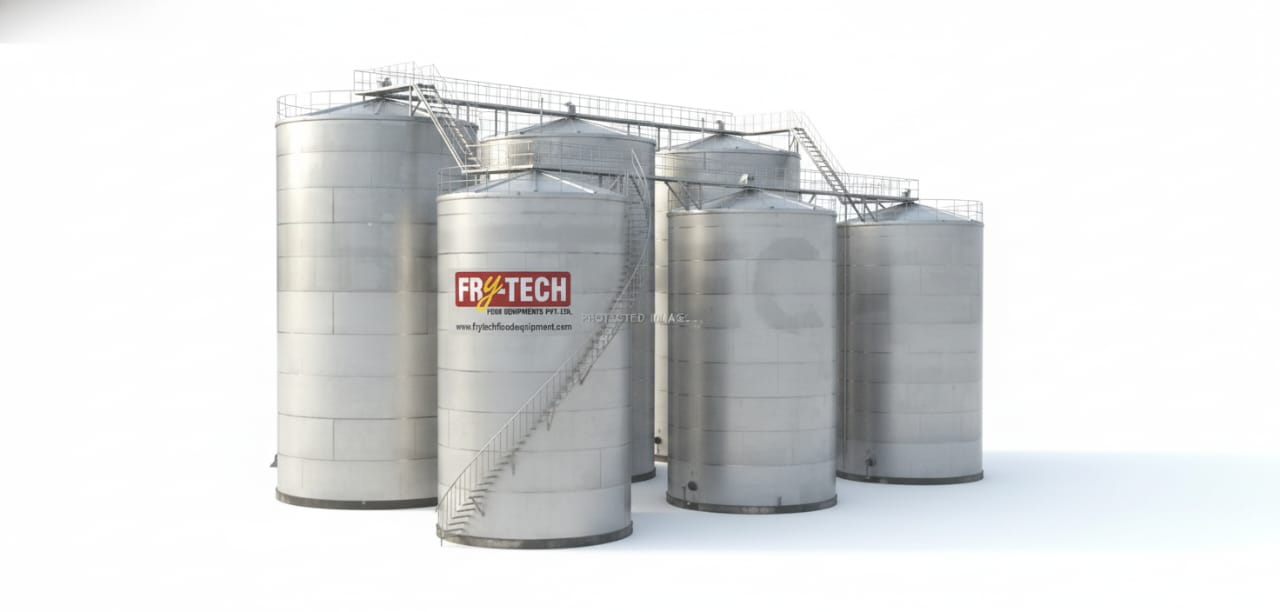
Edible Oil Tank
In a professional snack or food processing factory, an Edible Oil
Storage Tank Set (typically a 6-piece configuration) is used to store different
types of oil or to manage the "Day Tank" supply for multiple frying
lines.
For edible oils that solidify or become viscous in winter (like Palm oil
or Vanaspati), these tanks must be equipped with Indirect Heating Systems and Insulation
to maintain a steady temperature of 40 C to 60 C
1. Technical Specifications (Standard 1,000L to 5,000L Tanks)
|
Feature |
Industrial Specification |
|
Material (MOC) |
SS 304 or SS 316L (Food Grade Stainless Steel) |
|
Heating Method |
Internal Steam Coils or Electric Jacketed Heating |
|
Insulation |
50mm to 80mm Rockwool/PUF with SS Outer Cladding |
|
Capacity Per Tank |
500L, 1,000L, 2,000L, or 5,000L |
|
Set Configuration |
6 Units connected via a common header pipe |
|
Accessories |
Digital Temp Controller, Level Indicator, Breathing Valve |
2. Types of Heating Systems
- Electric
Jacketed (Common for Small Plants): The tank is "Double Walled."
The gap is filled with water or thermal oil heated by electric immersion
heaters. This provides very gentle, uniform heat.
- Steam Coil
(Common for Large Plants): A stainless steel coil is placed inside the
tank. Steam from a central boiler circulates through the coil to heat the
oil. This is much faster and more cost-effective if you already have a
boiler.
- Thermic
Fluid Heating: Uses a separate heater to circulate hot oil through the
tank jacket. This is used for very high-capacity refineries.
Key Benefits of a
"6-Piece Set"
- Oil Segregation: Allows you to store different oils (e.g.,
Sunflower, Palmolein, Cottonseed) separately for different product
recipes.
- Batch Rotation: You can use one tank while others are
being refilled or cleaned, ensuring zero downtime for your frying
machines.
- Sedimentation: Freshly arrived oil can "rest"
in one tank to let any sediments settle before being pumped into the
fryers.

