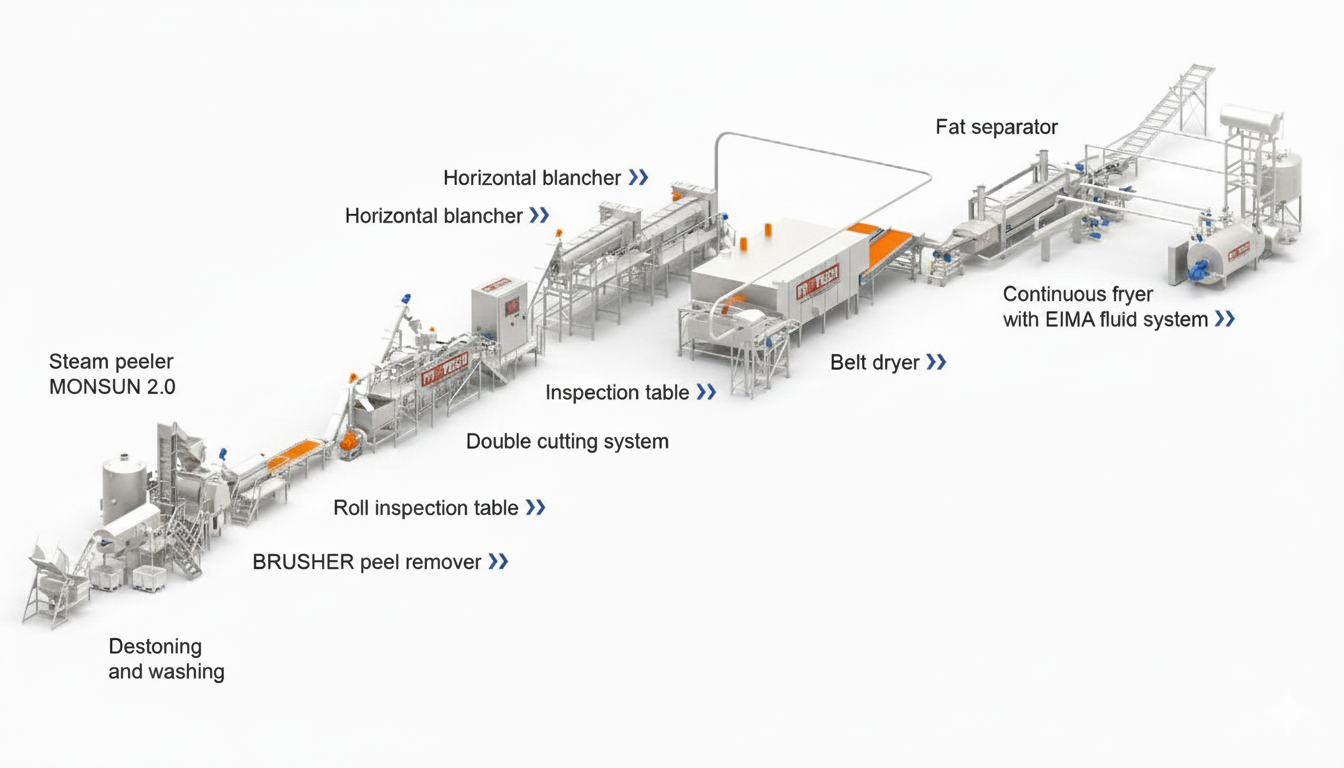
Fully Automatic Potato Chips Line
FRY-TECH fully automatic potato chips production line is an integrated "farm-to-bag" system designed to process raw potatoes into packaged snacks with minimal human intervention. To operate a high-capacity line (e.g., 300 kg/hr to 1,000 kg/hr), the machinery must be synchronized via a central PLC (Programmable Logic Controller) system.
1. The Production Workflow
The line follows a sequential process, ensuring that every chip is uniform in thickness, colour, and flavour.
Stage A: Raw Preparation
- Potato
Grader: A drum or roller-type machine that sorts potatoes by size to
ensure consistent peeling and slicing.
- De-Stoner:
A water-filled hopper with a vertical screw. Gravity pulls stones to the
bottom while potatoes float and move upward.
- Continuous
Peeler: Uses abrasive carborundum rollers to rub off the skin. A
"Sine Wave" design prevents the potatoes from flat-spotting.
- Inspection
Belt: A roller conveyor that tumbles the peeled potatoes so operators can
manually remove any remaining "eyes" or defects.
Stage B: Slicing & Pre-Treatment
- Slicer:
High-speed centrifugal slicers cut potatoes into plain or ruffled slices
(typically 1.2mm to 1.5mm thick).
- Blancher:
A hot water bath (70°C–90°C) that removes surface starch and inhibits
enzymes. This prevents the chips from turning dark brown during frying.
- Belt
Dryer (Air Knife System): Uses high-velocity fans and air
"knives" to strip surface moisture. Removing this water is
critical to saving oil and reducing frying time.
Stage C: Frying & Sorting
- High-Speed
Conveyor: Transfers dried slices into the fryer in a thin, even layer.
- Continuous
Fryer: The "heart" of the line. It features an internal heat
exchanger, a dual-belt submerge (to keep chips underwater), and a
continuous oil filtration system that removes "fines" (starch
particles) every minute.
- Cooling
Conveyor: Fried chips travel over a mesh belt with ambient air fans to
drop the temperature before seasoning.
- Colour
Sorting Conveyor: An optical sorter uses high-speed cameras to detect and
"air-blast" out any burnt or discoloured chips.
Stage D: Flavouring & Packaging
- Flavouring
Sprayer & Drum: A liquid oil sprayer first mists the chips, followed
by a dry powder applicator. The rotating "Zig-Zag"
drum ensures 360-degree coverage without breaking the chips.20
- Multi-Head
Packing Machine: A 10 or 14-head weigher accurately measures the weight
(e.g., 30g) and drops them into the bagger, which flushes the bag with Nitrogen
for shelf-life before sealing.21
2. Technical Requirements (300 kg/hr Line)
Specification
Requirement
Power Consumption
Approx. 65 HP to 75 HP
Water Consumption
2,000 to 3,000 Liters / Hour (Recirculated)
Floor Space
Minimum 3,000 to 4,000 Sq. Ft.
Fuel (Fryer)
Wood or Natural Gas
Material
All contact parts AISI 304 Stainless Steel
Electroporation (PEF): New lines are replacing blanchers with Pulse Electric Field (PEF) systems. This uses electricity to open potato cells, resulting in a crunchier chip with 10% less oil absorption.
Smart Oil Management: Systems now monitor the Acid Value of oil in real-time, automatically adding fresh oil to keep the "turnover ratio" high and the quality consistent.
AI Sorting: Colour sorters now use AI to distinguish between "green" potato edges and "burnt" spots, reducing waste of perfectly good chips.
- Potato
Grader: A drum or roller-type machine that sorts potatoes by size to
ensure consistent peeling and slicing.

