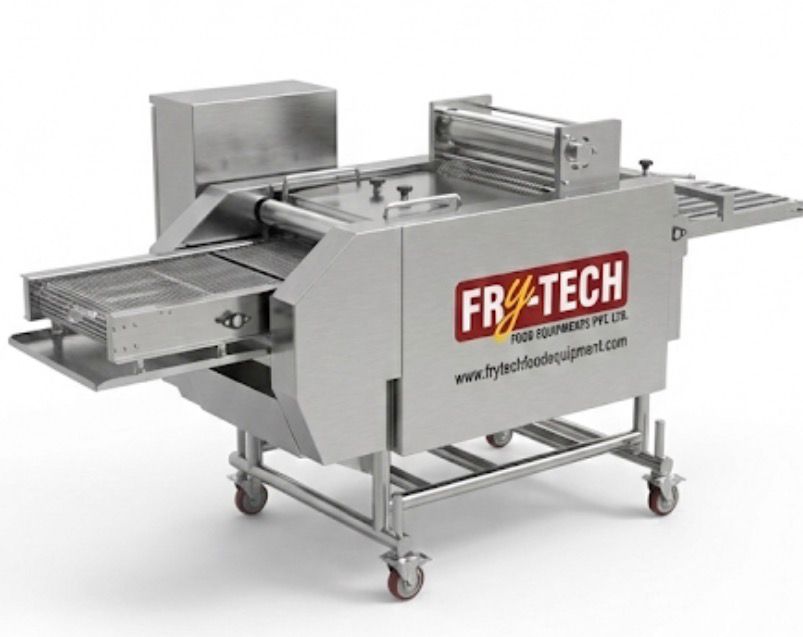
Gas Fired Fryer Small Panipuri Fryer Machine
small-scale, automatic Panipuri (Gol Gappa) fryer, a
gas-fired system is highly recommended because it provides the rapid, intense
heat needed to "pop" the puris instantly. Unlike nuggets or beans,
Panipuris require a specific vortex or circular oil flow to ensure they rotate
and puff up into perfect spheres.
1. Types of Automatic Panipuri Fryers
A. The "Vortex" Circular Fryer (Most Popular)
This machine uses a circular tank with a motorized
"paddle" or "wiper."
- How
it works: Raw pellets are dropped into the center. The rotating paddles
move the puris in a circular motion through the hot oil.
- Automation:
Once puffed, the puris are automatically guided to a discharge ramp and
pushed out into a collection basket.
- Benefit:
Ensures 100% puffing rate and prevents the puris from sticking to each
other.
B. Continuous Belt Fryer (Linear)
A miniature version of industrial snack lines.
- How
it works: A mesh belt carries the puris through a rectangular gas-heated
tank.
- Benefit:
High consistency and easily integrated with a cooling conveyor.1
2. Key Technical Specifications (Small Scale)
|
Feature |
Specification |
|
Capacity |
20,000 to 50,000 Puris per hour |
|
Heating Method |
Gas Fired (LPG or PNG) with High-Pressure Burners |
|
Material |
SS 304 Food Grade Stainless Steel |
|
Motor |
0.5 HP to 1 HP (Variable Speed Control) |
|
Fuel Consumption |
Approx. 0.5 to 1.5 kg of LPG per hour |
|
Dimensions |
Roughly 3ft x 3ft (Space-saving design) |
3. Why "Gas Fired" for Panipuri?
Panipuris are made from semolina or wheat pellets that
need to hit high-temperature oil ($190$°C to $200$°C) to expand.
- Rapid
Recovery: Gas burners recover heat much faster than electric coils when a
new batch of "cold" pellets is added.
- Operational
Cost: In India and many other regions, LPG/PNG is significantly cheaper
than electricity for high-heat frying.
- Flame
Control: Modern automatic gas fryers include a Solenoid Valve that
automatically turns the flame up or down based on the oil temperature
sensor (PID Control).
4. Automation Features to Look For
- Automatic
Igniter: No need for manual lighters; the machine sparks automatically.
- VFD
(Variable Frequency Drive): Allows you to slow down or speed up the
paddles. If the puris are browning too fast, you speed up the discharge.
- Temperature
Controller: A digital display that shuts off the gas flow if the oil
reaches the set limit, preventing oil fire or smoke.
- Oil
Filter Tray: A mesh tray at the bottom to catch any broken puri pieces
before they burn.

