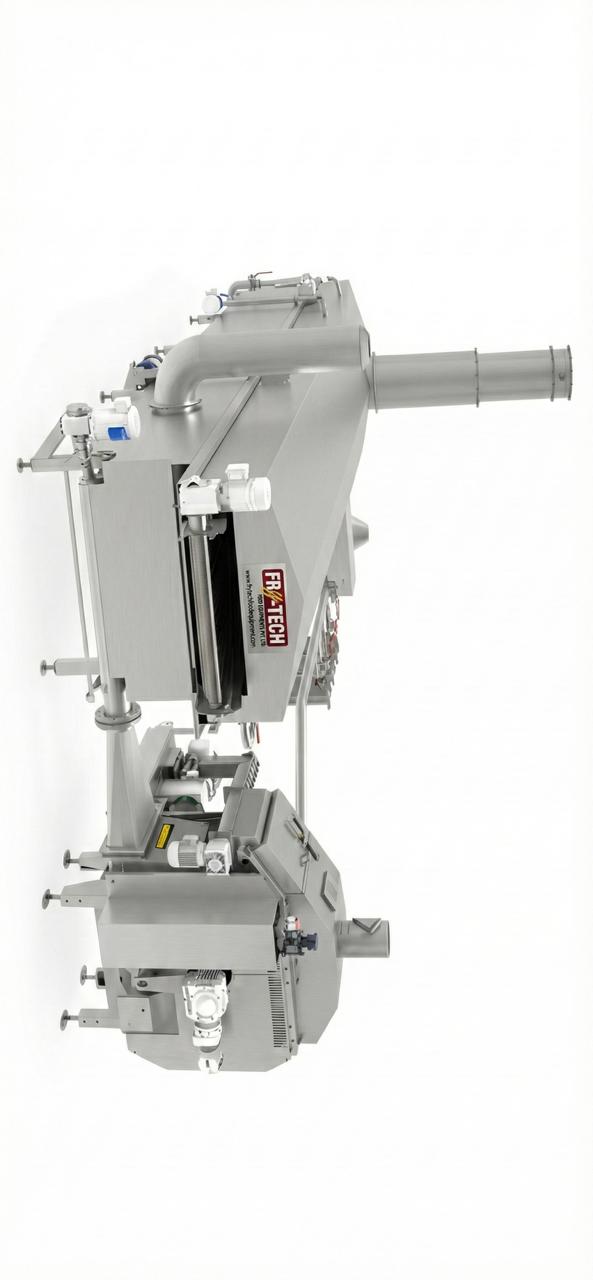
Pulses Fryer Machine
Automatic pulses
fryer machines are specialized systems built to handle small, granular products
like Moong Dal, Chana Dal, Masoor Dal, and Fried Peas. Unlike nugget or spring
roll fryers, these machines must manage "non-floating" products that
sink to the bottom and require high-intensity filtration to remove tiny
particles (fines).
1. Key Technologies
for Pulse Frying
Pulses present two
specific challenges: they are small (easy to lose in the system) and they sink.
- Continuous Basket or Fine-Mesh Conveyor:
To prevent small grains from falling into the heating elements, these
fryers use ultra-fine stainless steel mesh belts or a series of traveling
baskets.
- Vibratory De-Stoning & Feeding: Before
frying, pulses are passed through a vibratory feeder to ensure a thin,
even layer enters the oil. This prevents clumping and ensures every grain
is perfectly crisped.
- Rapid Oil Circulation: High-velocity oil
flow is used to "tumble" the pulses as they cook, ensuring
360-degree heat exposure.
- Intense "Fines" Filtration:
Because pulses often shed their outer skins during frying, these machines
feature dual-stage filtration that can remove particles as small as 50
microns to keep the oil from turning bitter.
2. Technical
Specifications
|
Feature |
Pulse Frying
Line (Small to Large) |
|
Production
Capacity |
60 kg/hr (Small)
to 1,000+ kg/hr (Industrial) |
|
Heating Methods |
Thermic Fluid
(Best for Dal), Gas, Diesel, or Electric |
|
Material |
Food Grade SS 304
/ SS 316 |
|
Typical
Temperature |
170°C to 190°C
(338°F to 374°F) |
|
Automation |
PLC-based control
with recipe management for different dal types |
3. The Fully
Automatic Pulse Line
A complete
industrial pulse frying line (like those from Economode or Jas Enterprises)
includes:
- Soaking & Dewatering: Removes excess
moisture before the dal hits the hot oil (critical for safety and oil
life).
- Feeding System: Controlled hopper and
vibratory tray.
- The Continuous Fryer: The heart of the
system with automatic temperature regulation.
- De-oiling Centrifuge: A high-speed
"spinner" or vibrating screen that removes surface oil so the
pulses are "dry" and crunchy.
- Cooling & Seasoning: An automatic drum
that applies salt and spices while the product is still warm for better
adhesion.
4. Why
"Thermic Heating" is Preferred for Pulses
Most professional
pulse fryers use Indirect Thermic Fluid Heating.
- The Reason: Pulses require very stable
temperatures. In direct-fire systems, the temperature drops rapidly when
cold, wet dal enters the oil.
- The Benefit: A thermic system has high
"thermal mass," meaning it recovers its temperature almost
instantly, ensuring the dal doesn't become oily or soggy.

